The Saddle That Helped Name a Legendary Club
There is a particular kind of story that only the American West could produce, the kind where a Swedish immigrant’s saddle shop, a record-breaking aviatrix with a taste for ranching, and a war hero who just wanted a comfortable ride all converge in a single afternoon on the Mojave Desert and give birth to a name that would become part of aviation folklore. This is that story.
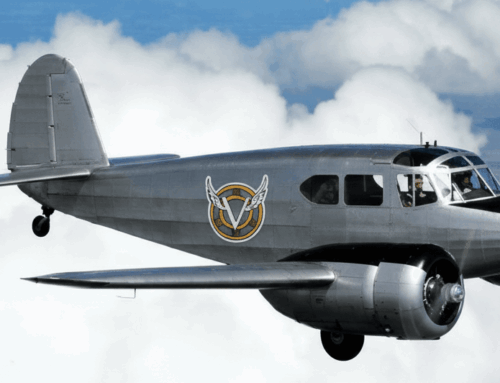
By the spring of 1946, after the close of World War II, Pancho Barnes had been building something remarkable on her 360 acres at the edge of Muroc Army Air Field. What had started as a working alfalfa operation and livestock ranch, the place she called Rancho Oro Verde for the green gold she was pulling from the desert soil, had been growing steadily into something larger and louder and more distinctly Pancho. She had created a guest ranch with a bar, a restaurant, a dance hall, stables, a rodeo stadium, a quarter horse racetrack, a swimming pool that glowed like a beacon for pilots flying over the dry lake bed at night, and a landing strip so that her guests could fly in. The name had already evolved once, from Rancho Oro Verde to the Rancho Oro Verde Fly-Inn Dude Ranch after she improved the airstrip. But she was still looking for the right name, the one that would stick, the one that would tell you everything you needed to know about the place before you ever set foot on the property.
Pancho knew all about good equestrian equipment. She had grown up surrounded by it. Her family, both the Lowe side and the Dobbins side, had been patrons of the finest Western craftsmen since the early days of Hollywood, and by the 1920s that meant one man above all others: Edward H. Bohlin.
Bohlin had come a long way from the four-masted schooner that carried him from Sweden to America as a teenager. He had worked cattle drives in Montana, learned his craft with leather and silver, and eventually opened his first shop in Cody, Wyoming, right across the street from the Irma Hotel, Buffalo Bill’s old place, where he would stand out front performing rope tricks just to pull customers through the door. It was in Cody that he caught the eye of Tom Mix, the Western motion picture star, who told the young Swede to come out to California, that Hollywood was full of real cowboys and men playing cowboys in the pictures, and every one of them would want what Bohlin could make. By the mid-1920s Bohlin had done exactly that, formally organizing the Edward H. Bohlin Company in Hollywood in 1926. The shop moved several times over the next two decades before settling at its most famous address, the corner of Highland Avenue and Sunset Boulevard, right at the crossroads where the real West met the manufactured one, where working ranchers and movie stars stood side by side at the counter flipping through the same catalog of parade saddles and sterling silver trophy buckles.
The Lowe and Dobbins families had been among Bohlin’s early customers, drawn to the quality that set his work apart from everything else on the market. When Pancho walked into that shop in May of 1946 to place an order for new saddles, she was continuing a family tradition that stretched back more than two decades. But she wasn’t looking for parade silver or show tack. Pancho wanted riding saddles, comfortable ones, the kind of saddles you could sit in for hours crossing the desert floor without your back seizing up or your legs going numb. She was running a guest ranch, and some of her guests were not casual riders. They were military men, test pilots, aviators, engineers, men whose idea of relaxation was putting a horse through its paces after a day of putting experimental aircraft through theirs. They needed saddles that worked as hard as they did.
Bohlin understood the assignment. He always did. The man who had crafted more than 12,000 saddles in his career, who had outfitted Roy Rogers and Gene Autry and the Lone Ranger and Clark Gable and John Wayne, knew the difference between a saddle built to look beautiful in a Rose Parade and a saddle built to feel right after riding for ten miles in the desert. What he delivered to Pancho that summer was both.
Two months later, in July of 1946, Lieutenant General Jimmy Doolittle drove out to the ranch for a barbecue. Doolittle had left active military duty in January of that year, reverting to inactive reserve status at the grade of three-star general, a distinction almost unheard of for a reserve officer in that era. He had returned to civilian life as a vice president at Shell Oil, but he was still the renowned war hero, Jimmy Doolittle, the man who had launched sixteen B-25s off the deck of the Hornet in April of 1942 and changed the trajectory of the Pacific war with a single audacious raid on Tokyo. He and Pancho had been friends since the 1920’s, bound together by a shared love of flying and an absolute refusal to be bored by anything, including each other.
After the steaks and the drinks and the stories that always circled that bar like dust devils on the lake bed, Pancho suggested they go for a ride. She saddled Doolittle’s horse with one of the new Bohlins, cinched it up, and sent him out across the property. They rode together for a good long while, the way you do when the Mojave evening light turns everything golden and the heat finally loosens its grip on the valley and the Joshua trees throw long shadows across the hardpan.
When they came back in, Pancho looked at Doolittle and asked him how he liked the new saddle.
Doolittle grinned. “It gave me a happy bottom.”
 Pancho Barnes had been looking for the right name for her club for months. She had tried Rancho Oro Verde. She had tried the Fly-Inn Dude Ranch. And there it was, handed to her by her old friend, now a three-star general sitting on a Bohlin saddle with desert dust on his boots and a cold drink in his hand.
She renamed the operation the Happy Bottom Riding Club on the spot, and Jimmy Doolittle became its first member. In a few short years, the membership rolls would swell to more than 9,000 members worldwide, a roster that read like a who’s who of aviation, military leadership, and Hollywood royalty. Chuck Yeager, Bob Hoover, Scott Crossfield, Pete Everest, Jack Ridley, Buzz Aldrin, Hap Arnold. Heads of state and movie stars and the fastest test pilots on earth all drinking at the same bar, riding the same horses, sitting in the same Bohlin saddles.
But it began with three people and a piece of leather and silver. A Swedish immigrant who understood that a great saddle is a conversation between the craftsman and the rider. A woman who understood that the best names are not invented but discovered, overheard in a moment of honest pleasure. And a war hero who understood that after everything he had been through, the thing worth remarking on was the simple comfort of a good seat on a good horse on a fine July evening in the California desert.
That is how the Happy Bottom Riding Club got its name. And if the story sounds too good to be true, too perfectly Western and too perfectly Pancho, well, that is because you never spent an evening at her bar. Everything about that place was too good to be true, right up until the night it burned to the ground. But that is a story for another time.
© Pancho Barnes Trust Estate. All rights reserved.